
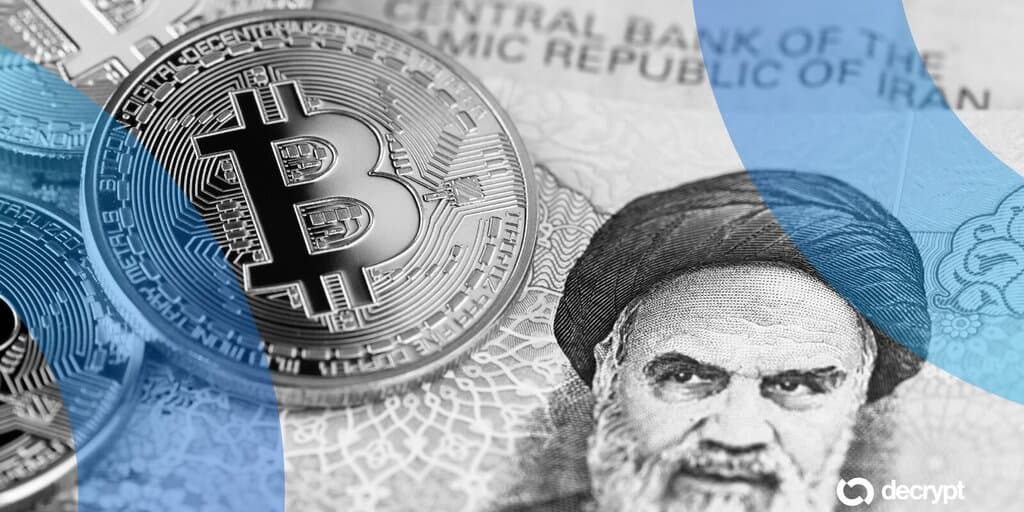
Bitcoin has demonstrated remarkable stability compared to traditional risk assets during recent market turmoil, driven by geopolitical tensions and an oil shock.
In brief
- Oil prices are climbing back toward $100 a barrel as tensions around the Strait of Hormuz escalate.
- Bitcoin remains range-bound after months of deleveraging earlier this year.
- Analysts say this week’s flash PMI data could shape expectations for interest rates and risk assets.
Bitcoin has fallen over the past week, but its declines have been less severe than the broader equity drawdown since the Iran conflict began on February 28.
The world’s largest crypto traded around $68,000 on Sunday, down roughly 2% over the past 24 hours and about 6% over the past seven days, according to CoinGecko data.
The move comes as the Iran war entered its fourth week, pushing crude prices higher and contributing to a broader pullback in risk assets by Friday.
That geopolitical backdrop worsened over the weekend after U.S. President Donald Trump gave Iran a 48-hour ultimatum to fully reopen the Strait of Hormuz or face U.S. strikes on Iranian power plants, prompting Tehran to threaten to completely shut the vital oil shipping route and target U.S.-linked energy infrastructure across the region.
U.S. stocks have fallen for four consecutive weeks, with the S&P 500 last week breaking below its 200-day moving average, a key technical level closely watched by institutional investors, for the first time since March of last year.
Both the S&P 500 and the Nasdaq are down about 4% to 5% this month, according to Google Finance data.
Energy has been the only major sector to rise during the period as oil prices begin climbing back toward $100 a barrel.
Still, Bitcoin’s monthly decline has been more modest than the drop in equities, posting a loss of just 0.2%, a shift some market participants attribute to earlier deleveraging in the crypto market and continued institutional participation.
Bitcoin Trails Money Supply Growth as Energy Costs and Rates Bite Bitcoin is trading at a steep discount to global liquidity trends, according to new analysis from CF Benchmarks, even as macro headwinds tied to energy prices and monetary policy complicate the outlook for risk assets and economic growth.
Global M2 money supply has risen about 12% since mid-2025, while Bitcoin has fallen roughly 35% over the same period, the Kraken-owned index provider said.
One model cited in its report, published Thursday, implies a “fair value” of about $136,000, compared w...
“After undergoing several rounds of deleveraging in recent months, Bitcoin has materially outperformed traditional assets on a risk-adjusted basis since the start of the Iran war,” John O’Loghlen, managing director for APAC at Coinbase, told Decrypt.
He added that as oil becomes “an active transmission channel for global inflation,” the firm is seeing rising institutional inflows into crypto assets and U.S. Bitcoin ETFs.
“There are early signs the crypto market might now be past peak pessimism,” O’Loghlen said. “However, stronger participation will be required for a more durable rally.”
While macro conditions are driving broader market sentiment, experts say the crypto market itself is flashing signs of resilience rather than heavy distribution.
“The crypto market is in a steady consolidation phase, with clear signs of institutional strength and accumulation,” Nischal Shetty, founder of WazirX, told Decrypt.
He added that Bitcoin has been holding support near the lower end of its recent range while facing resistance near recent highs, signalling buyers remain active despite macro uncertainty.
A mid-March ChainCheck report from VanEck found that long-term holder selling has slowed, with transfer volume declining across older coins, a sign that experienced investors are reducing distribution pressure.
Analysts say the next move for Bitcoin will likely depend on macroeconomic data in the coming week, including flash PMI readings from major economies and further moves in oil prices, which are increasingly shaping expectations for inflation and interest rates.



Comments
No comments yet
Be the first to share your thoughts and start the conversation!